Thursday, March 17, 2011

Jean Luc Godard - introduction


Jean Luc Godard may be both one of the worlds most rewarding and disappointing filmmakers. His work ranges from masterful to utterly terrible, and during the 60s alone, he has dabbled in such varied genres as in war films, musical, sci-fi and political thriller, among others. Always colorful - even if directed in black and white, his films were an unique oddity back when they were conceived, and still stand out today.

However, there is one major problem with his body of work. As enjoyable as some of his films may seem, Godard himself has always tried to push his own intentions into the foreground, resulting in works that seem helmed by a professor of sociology rather than a director, bordering on boring and even wanky excursions on socialism and dadaism.

As curious I was in the beginning, the more cautious I have become with this mans body of work as I further followed his lead. Among the 16 films he directed during the 60s (resulting in a dead end - the two essay-films Le Gai Savoir and Un Film commes lest autres - but not before turning a documentary on the Rolling Stones into a raging and messy political manifest) are some of my favorite films and some which I hope I never have to lay an eye on again.

As I worked my way through these films, many I talked to about his work requested I should review or analyze his films one by one. So after finally finishing all 16 aforementioned works, and with Godard all over the news again (the now 80 year old was awarded with the lifetime achievement academy award as well as others, released his latest feature, Film Socialisme and will have eight highly experimental and divisive films previously not released in germany included in a DVD box-set), I decided to give this a go, and write down my thoughts on his run during the 60s.

But before I start, it is necessary to sum up Godard during that period of time. It is important to note that Godard did not start a filmmaker, but earned his money as a film critic of the popular journal Cahiers du Cinéma, mostly composing reviews not too keen on "classic filmmakers", such as Ingmar Bergman and Henri-Geroges Clouzot. It is of high importance that Godard himself felt frustrated with the filmmakers of his age, requesting a style to match his generation. With hardly any budget, he set out to direct his first short films "on the run" - with hardly a script and equipped only with a camera (mirroring the manifest of the Dogma-movement three decades later). No matter what one might think of Godard's opinion as a critic during that time, this approach has to be applauded, especially in a time in which shooting without a proper studio attached was unthinkable.

Thus, Godard was looking for the language of a generation. And he found it in two slackers.

Sunday, November 7, 2010

--- .-. .--. .... . ..- ...


1.) I'm moving into a new flat!! Yay!!!

2.) I'm currently re-writing "Any Other Day / Jeder Andere Tag". When I wrote the screenplay, I was very influenced by realist filmmakers, such as Michael Haneke and Takeshi Kitano. Reading it now, I found a few flaws - in general, it feels something so detached from my current style (or the style I intended it to have from the beginning) that the script needs to be changes, and whaddayaknow, since I got some time on my hands, I decided to re-write some parts of it. Can't tell how much it is as of now, but it'll be a lot darker and a lot closer to the psychedelic-noir style I intended the visuals to be.
I'm very proud of some parts though... thinking that the first rough draft/treatment was done three years ago is quite shocking, because it still feels so fresh and exciting. It just needs the right atmosphere and coloring.

3.) Some cool things ahead I don't want to talk about just yet. Ha.


Friday, November 5, 2010

five eleven


The soundtrack for ABORT is finished!! Yes!!! Hooray!! And I'm terrified how great it is. Expect to see the film VERY SOON near you!!!

Apart from this, it's rather looking dire outside. It's a sea of yellow leaves on a dark grey sky - the sun hasn't shone for days, there's storms at night, and I seriously considered to go out and do an improvised short of two teenagers who live in a post-apocalyptic world, in which their parents called one of the Old Ones. No sun for weeks and 98% of the population gone, the kids have to swallow big red pills to stay healthy, now and then need to cover their faces behind masks in case one of the Old Ones walks/rumbles by and have pretty much nothing to do all day long... not sure yet if it's a good idea or is suited for a fun short, and I guess it's up to the people I'll ask if they participate if it is.

Apart from that, here's some more great stuff I've been checking out recently that I find to be quite inspiring.


Think I don't have to say anything to introduce Rosey. Perfect album. Buy it.


If there's something that screams instant fun to me, it's scene kids in comics (or film, I'm looking at you, KABOOM), and Suburban Glamour is pretty much what makes scene kids great. Imagine two teenagers who're living in the middle of nowhere, obsessed with pop culture and music, as realistic as they are ridiculous - there's not much apart of occasional sex, drugs, school and nagging parents, until our heroine finds out she's sort of in the middle of a faerie war. It's hilarious, and by the co-creator and penciler of Phonogram, which you hopefully have read by now. The book's also cheap as hell, you can get it for 7 Euros on amazon. Not bad at all!


Saturday, October 16, 2010

Tuesday, August 31, 2010

FFF Review: RUBBER


Surrealism has come a long way, slipping into the obscure, hiding in the form of third class horror films in the lower cases on the shelves of rentals, residing on hardly frequented websites as fainted VHS copies or occasionally making an appearance as a supporting genre in films by arthouse directors such as David Lynch. There hasn't been a mainstream film that could be attributed a work of a surrealist in decades. Maybe there's never really been one to begin with... up until now.

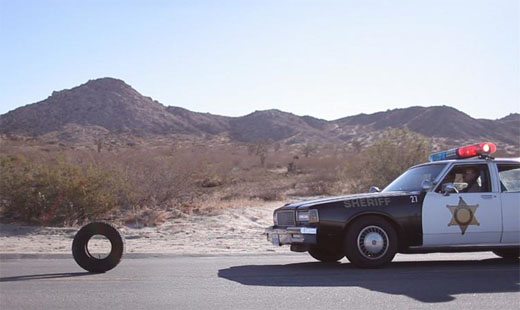
Up until Quentin Dupieux, aka. Mr. Oizo, took up directing and made RUBBER. A film about a tire who can kill due to his... powers. And falls in love with a girl. And is chased by the police.


To tell you anything else about the plot would be to spoil the movie and the experience of watching it. If you intend to watch RUBBER, then do so with an open mind and without a clue what it is about, apart from including a killer tire as the protagonist. Because, most of all, RUBBER is a film about filmmaking. A film about nonsense, a film about the poetry of sheer silliness and about the surreal. A film about clichés, both of films and of life.

RUBBER could also have been labeled UN CHIEN ANDALOU 2. To be honest, if it would have been, it would have only improved its grandeur, because most of all, the film does introduce us Quentin Dupieux as one of the greatest artists of our age, placing him next to Artaud or Bunuel.

So if you watch RUBBER, do so in a cinema - the visuals are stunning. Take some friends and alcohol along, and prepare to laugh a lot!!! As the closer of this years Fantasy Filmfest, RUBBER allowed its audience to gaze one last time at the grandeur that is filmmaking aside the norm, aside of such boring productions like "The Sorcerers Apprentice" or "The Forgotten". Aside of everything logic and sane.

And thus, I leave the filmfest with one big question in my mind - to quote the film I have just seen:

"Why does the guy from Roman Polanski's THE PIANIST have to hide and live like a bum if he can play the piano so well?"

You think you know the answer? Oh, you have no clue...

Rating - 9.5/10


FFF Review: THE SILENT HOUSE


In my last review, I ranted a bit about the problem of novelty in the horror-film genre. Well, consider the film I saw right after CAPTIFS to completely blow my prejudices away. THE SILENT HOUSE, this quiet and only secretly hyped ghost-house film from Uruguay (!!) is everything you can wish from a horror film and more.

Get this: THE SILENT HOUSE was shot in one single take, without any cuts!! From beginning to end, there is no pause. It's all one long shot!!


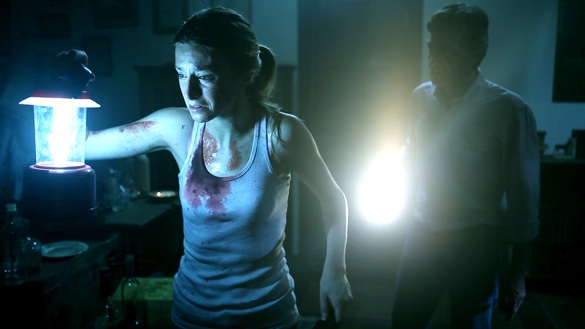
The film opens as a girl and her father approach a run down house. Why there are here is a unknown, a second man reveals that they will do work in the house, but what kind that is remains a mystery to us. So the second man leaves as father and daughter get inside the house and try to take a nap. However, the daughter is woken up by some strange noises from upstairs, and wakes her father. The old man tries to calm her down and then goes upstairs to take a look. The daughter stares at the ceiling in horror, as all she hears is her fathers scream and a loud thud.

THE SILENT HOUSE manages to convey the sense of dread and doom as the girl further searches the house for her father or for clues as to what is taking place around her. With minimal dialogue (and no subtitles, as those ran 20 seconds before their actual position in the film, causing the entire audience to ignore them), the film manages to suck us into the house - there are no cuts, no moment of rest or of re-assurance that all will be well - it's one long shot of creepy situation after creepy situations, with dozens of jumps and plenty of opportunities to calm down scared girls.

THE SILENT HOUSE is a masterpiece in its own right that will surely receive every bit of hype it has deserved. One of the most unique and atmospheric horror films in years, it has to be seen to be believed.

Rating - 9/10


FFF Review: CAPTIFS


It's hard for French horror these days. Sure, they get a lot of funding, some of the best actors and technicians in the country and a wide release with good promotion. But if we leave those technical achievements aside, almost every film that came out after MARTYRS looked and felt like a bit of a let down. Maybe that is due to the quality of films like ILS, MARTYRS, FRONTIERS and INSIDE, but maybe it's also due to the one big problem the horror genre has suffered from for decades now: that of expectations.

A horror audience knows all great horror films of the last few years - at least those that are considered the recent classics. Hence, there are only two ways left to go - either you make a great film out of a plot constructed around clichés and well known genre-moments, or you come up with something completely new (you can also come up with something old and present it in a way it's never been presented before). CAPTIFS - or CAGED - settles for the former.


So here's our plot: a few nice doctors in the the Kosovo try to get from point a to point b. On the way, they are ambushed and taken into captivity. They try to figure out why the are held captive, until the scheme of the the kidnappers is unveiled. The rest of the film pretty much uses the same plot devices like most of those genre films (one in particular I don't want to spoil). So yeah, if you've seen this kind of film, you know what's coming.

However, CAPTIFS is quite well made. The highlights of the film are the first three minutes as well as a dream sequence, that prove that director Yann Gozlan is better at generating suspense than go for mindless horror territory that others have tread before him. If this is one of your first films of this kind, you will surely be amazed, due to the great actors, great cinematography and suspense in some scenes, but the film does leave a bit to be desired. However, for the aforementioned qualities of the film, it still holds up pretty well.

Rating - 7.5/10


FFF Review: AMER


Like me, you'll be staring at those pictures here right now. That looks cool, doesn't it? Somehow, this would have been my summary for AMER, but I feel obliged to say some more about the film than just post pictures out of it.

AMER is most of all an homage to the Giallo-genre. If you have no idea what a Giallo is, just follow this link. If you do know what a Giallo is, you might be drooling all over your keyboard right now. But AMER is not a straight Giallo - it also includes elements of avant-garde cinema, reminiscent of the works of Kenneth Anger, Luis Bunuel's UN CHIEN ANDALOU or Alejandro Jodorowsky's EL TOPO. Most of all, it is a coming of age drama, and a film about sexuality.


Amer is the brainchild of two belgian artists: Helene Cattet and Bruno Forzani. The film is loosely cut into three acts: the first is centered on Anna as a little girl and both looks and feels very much like Dario Argento's classic gothic horror film SUSPIRIA, including some supernatural elements.


The second act concerns Anna as a teenager, rather resembling Lucio Fulci's early Giallo, such as LIZARD IN A WOMAN'S SKIN, than SUSPIRIA. Less colorful than the previous part, but with a great original 60s/70s soundtrack, this was my favorite part of the film. We really see the world through the eyes of a teenage girl, and feel what she feels.


The third act concerns Anna as a woman, inheriting the house she grew up in as a child. This one feels a lot like Argento's PROFONDO ROSSO, and is the act that is closest to the straight Giallo genre. This was in my book the weakest part - it still wasn't bad, but it was overtly cryptical and came quote out of nowhere. I'm not really sure if this is in synch with the other two parts, as it shows a side of Anna that has been obscured for the viewer and that isn't thoroughly explained.


Amer does belong on the big screen, even though it isn't a usual film. It follows nothing but its own rules, as the directors try to make us see and feel what Anna experiences. Close ups, silent sounds and subjective shots with mostly no dialogue set the atmosphere, and boy, is it a gorgeous atmosphere.

In the end however, the film leaves a bit to be desired. The ending is quite strange (as is the entire third act), and even though it's all quite easy to analyze and to understand, the background to the world of Anna is never fully supplied, questioning what else it is this woman has experienced in her life. We know her experiences - but we don't know her story.

But maybe it is this elusive plot that creates the magic of AMER, one of the most unique and thrilling films in recent years. I will re-watch this film as soon as I can, because I can see myself appreciating it a lot more the second time around, focusing a bit more on analytical subtext - but even without a second viewing, I am sure that this is a cult film in the making, pleasing both arthouse and horror fans!! There's nothing like it - really!!

Rating - 8.5/10


FFF Review: OUTRAGE


After 10 years of poetic arthouse lyricism (DOLLS), blind swordfighters (ZATOICHI) and a trilogy of self-demontage-comedies, Takeshi Kitano is back at the genre he loves and helped to re-create - the yakuza film!

With films like HANA-BI, BROTHER, SONATINE and BOILING POINT, Kitano can be billed the master of the japanese crime-drama. All of these films are precise, sensual portraits of men closer to death than life. Kitano once reported that out of the gang that he was a member of as a teenager, only 8 of the 10 are still alive. Maybe it is a cynical life view, maybe it's just realistic, but Kitano knows that almost no gangster will end up on the top, and those that do stand on the dead bodies of their former friends.


Hence OUTRAGE is a bitter and realistic story: because the "chairman" doesn't like an underboss, he asks another underboss to start a fight with him - for no apparent reason. Even though the two are friends, the gangster agrees, and what starts out as a small fight soon becomes a blood feud with dead bodies, dismembered fingers and drilled teeth everywhere. The various gangsters all see the downfall of their direct opponent as a chance to rise to the top, and so they quickly start to scheme who could be erased by whom, and who could be set up against which foe.

Even though the film doesn't add anything new to the genre, there's a lot of substance and entertainment in OUTRAGE. However, Kitano's newest feature is by far not as sensual or playful as his earlier film (maybe that is an attribute of the previous trilogy of hysterical comedy films), but the bleak realism of OUTRAGE never fails to entertain. In the end, the film might be another stepping stone to something else, something bigger and more glorious, but as of now, it proves that Kitano is still one of the best directors worldwide.

Rating - 9/10


FFF Review: THE SCOUTING BOOK FOR BOYS


This seems to be the right moment to mention a few things concerning this years filmfest. First of all, the FRESH BLOOD category was absolutely outstanding this year. There was no film I disliked, and according to the organizers, there was only one film that on a scale from 1 to 6 hasn't had a 1,x ranking (the irony being that FOUR LIONS, which I skipped, seems to take away the audience award is proof of just how good this year was).

Second of, this year was a great year for british films. Whenever I see an independent film from the UK, I can be sure it at least has something to it that makes it worth paying money for.

And last but not least, this years filmfest managed to pull some of the most stunning and brilliant independent films out of nowhere. Seeing that some actually criticized this trend to arthouse cinema, I can only wonder what they were anticipating, since most of these films were a lot more thrilling and shocking than the horror films that aired.

And with this, we are at SCOUTING BOOK FOR BOYS, the debut feature of Tom Harper, that tells a tale of two teenagers, living in a british seaside resort.


The film opens with Emily and her best friend David jumping over some trailers, with David falling off of one. The two know each other since childhood, being the only two kids in what is a tourist infested spot near the seaside - there's not much there but trailers and their parents, who in turn aren't very great when it comes to their parental duties. Emily, who slowly grew into a young woman, is sick of being under her mothers thumb, and so she comes up with a scheme - David must help her in retreating to a nearby cave, hoping that by disappearing, she could force her mother to love her.

However, David has other ideas. As Emily is very uncomfortable with living in a cave (well, who would like it?), the young boy comes up with new ideas to care for her - he brings her food and clothing, and tries his best at proving to her that he could be - maybe - a perfect boyfriend, able to take care of her - kudos to Thomas Turgoose and Holliday Grainger for delivering powerful performances as the teenagers in question. They are both believable and likable.

In the outside world, things don't go that easy as they do in the cave: Emily's mother panics after the sudden disappearance of her child (well, who wouldn't?) and calls upon the police, who start a huge investigation, and gradually come up with some raunchy facts about Emily, which slowly undermine David's sympathy for her, providing various reasons why she could hide in a cave that are much darker than parental abuse.

Shot in an aesthetic remarkably close to that of directors as Sofia Coppola or Shunki Iwai, THE SCOUTING BOOK FOR BOYS is a calm, haunting and beautiful film about the pains of growing up and the everyday problems of both teenagers and the british lower class. There was some discussion about the ending of the film (in short - those who found it realistic loved the film, those who didn't hated it), but all in all, this is one more remarkably well made and engaging british independent drama that I'll surely add to my DVD collection.

Rating - 9/10


FFF Review: THE DISAPPEARANCE OF ALICE CREED


There is an unwritten rule for young filmmakers that is as logical as it is dull: if you shoot your first film, see that it is cheap. In fact, see that it is so cheap that it costs almost nothing.

Of course, in a time in which Christopher Nolan proves that 160.000.000$ are a worthy investment and in which Gaspar Noé takes some four years to shoot a film, this clause becomes all the more a painful obstacle for artists to re-create their vision. Trust me - coming up with a story including less than five actors in less than five locations is hard. Very hard.

So all I can do is applaud J Blakeson. He hasn't only managed to keep the budget down to a minimum, he also directed a well paced, stylish, engaging and - most important of all - suspenseful crime thriller, starring the absolutely stunning Gemma Arterton.


The film opens with the title-giving disappearance taking place. Alice Creed, a young woman with a rich father, is kidnapped by two crooks. They cuff her to a bed, rip off her clothes and shout at her. Now, telling you anything else is a spoiler, hence I leave it at that and rather concentrate on what is more important than the story: the actors.

Martin Compston and Eddie Marsan are absolutely great as the clever, yet clueless and clumsy kidnappers. As the story unfolds, we both feel resentment and sympathy with those two, as the situation really seems a bit much for them. But the film wouldn't be the film, and I wouldn't be me, if the biggest advantage wouldn't have been a lot more interesting and captivating than those two - and that is Gemma Arterton.

Arterton manages something truly unique here. We don't know anything about Alice Creed as we see her the first few times, and the british actress manages not only when it comes to conveying her terror and fear. She's one to fight back, to look for a way out, an advantage to get free. So Arterton does everything to convince both the kidnappers - and the audience - of what she is capable of. At one point helpless victim, in the next a tough negotiator and after that a raging fury, Alice Creed doesn't just give the title to the film but also its heart. Seeing as many actresses might have failed the part, one can only applaud Arterton for this achievement to act both convincingly and arrestingly well, turning the film into a one-girl-show.

THE DISAPPEARANCE OF ALICE CREED is not a perfect film though - which doesn't mean the film does have flaws. However, it is limited in space and money, and isn't creating the next DIE HARD as it is creating the next SLEUTH. But for what it is - a crime thriller set in an apartment with only three actors, one of it a naked woman (most of the time), the film is a stunning and suspenseful examination of three characters under pressure. You won't find many thrillers this year that thrilling.

Rating - 8/10


Monday, August 30, 2010

FFF Review: TETSUO 3 - THE BULLET MAN


Let's all take a minute to let the idea of a third Tetsuo film sink in. That's right, a third entry in the avant-industrial-horror-saga by Shinya Tsukamoto. Let's all remember how awesome Tsukamoto's VITAL - his best work to date and one of the best films of all time - is, how disturbed SNAKE OF JUNE left us in our seats, how shocking HAZE explored our most inner fears, how utterly scary and beautiful GEMINI was... and let's remember, that NIN are doing the OST for TETSUO 3.

Aaaaaaaaaaaaaaah.

This is awesome...

And as I sat down in my seat, opened a box of Sushi and started to eat, no way could I have ever imagined this to be the most painful film of the festival.


It's not that TETSUO 3 is bad. No, it isn't. If you get over the (intentionally) ridiculous plot, it's a lot of fun. Seizure inducing, messy, autism like fun.

But after some 50 minutes, I had to run out of the cinema. Screaming.

TETSUO 3 is one of the most over the top films I have ever seen. The action sequences are eardrum shattering, the visuals seizure inducing (you can't mention this one enough), the plot completely clueless of what it is or what it wants to be. Tsukamoto may have had fun with this, but it comes off like the work of a person suffering from autism - the director doesn't care what ends up on screen, he just does whatever he thinks is right in his head. Belonging rather in a museum of avant-gare video art than into a cinema - TETSUO 3 is a baffling, loud, messy and maybe even pointless affair, a techno DJ-set in film form, or something. It can be enjoyed, but the same goes for getting a tongue piercing. Personally, I would rate the film a 7, but the experience of watching it a 3. Maybe I will like, or "understand", this when it comes out on DVD, but as of now, I am deeply disturbed.

Rating - 5/10